Tabular RL on a Robot I Built
Sutton & Barto, but on a custom robot in PyBullet instead of a grid world
TL;DR I designed a small pick-up robot in Onshape, simulated it in PyBullet and solved it with ten classic RL algorithms from Sutton & Barto, from Monte Carlo up to n-step Q(σ).
Why
Working through Reinforcement Learning: An Introduction, I got tired of grid worlds. I wanted the algorithms to control something physical, so I built a robot for them. Two robot designs failed before this one worked, and I ran a lot of PyBullet experiments before the environment behaved.
The robot
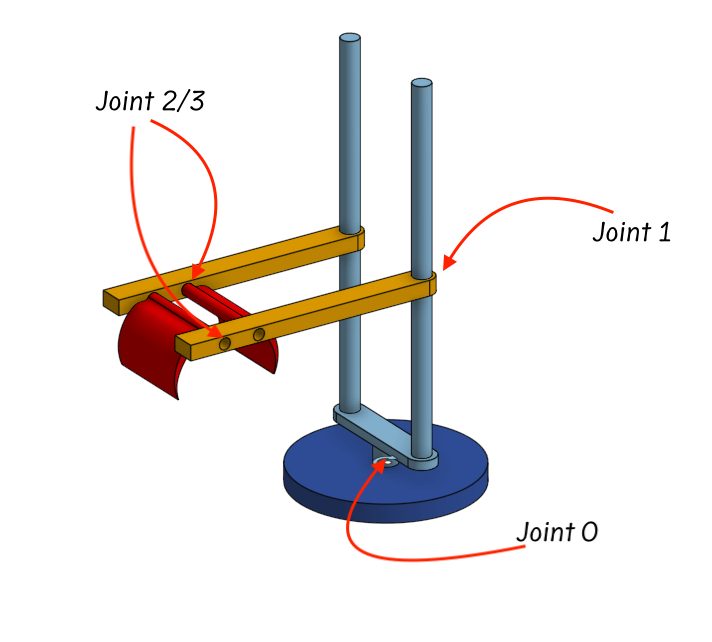
The state is a discretised tuple (stand rotation, slider height, gripper 1, gripper 2), which gives 24 reachable configurations. The goal is to find the most efficient sequence of moves to a target state.
Algorithms
- Monte Carlo: on-policy control without exploring starts, and off-policy control with importance sampling
- Temporal difference: SARSA, Q-learning, Expected SARSA and Double Q-learning
- n-step bootstrapping: n-step SARSA, n-step off-policy learning, n-step tree backup and n-step Q(σ)
- Plus k-armed bandits as the warm-up
One thing that tripped me up
PyBullet position targets are relative to where each joint started, not where it is now. So "move down 0.21" means something different depending on where the arm already is. Until I shifted every command by the joint's original pose, the robot kept overshooting, and the whole environment design depended on getting that right.